Static vs Dynamic QR Codes: Learn the difference, why dynamic QR codes are editable and trackable, and when to use each for your marketing campaigns.
If you are planning to use QR codes for your business or marketing campaigns, you will need to choose between two types: static and dynamic. While they look similar at first glance, they function very differently under the hood. Choosing the wrong type can ruin a print campaign, costing you time and money. Let's explore the differences between static and dynamic QR codes, and which one is right for your project.
What is a Static QR Code?
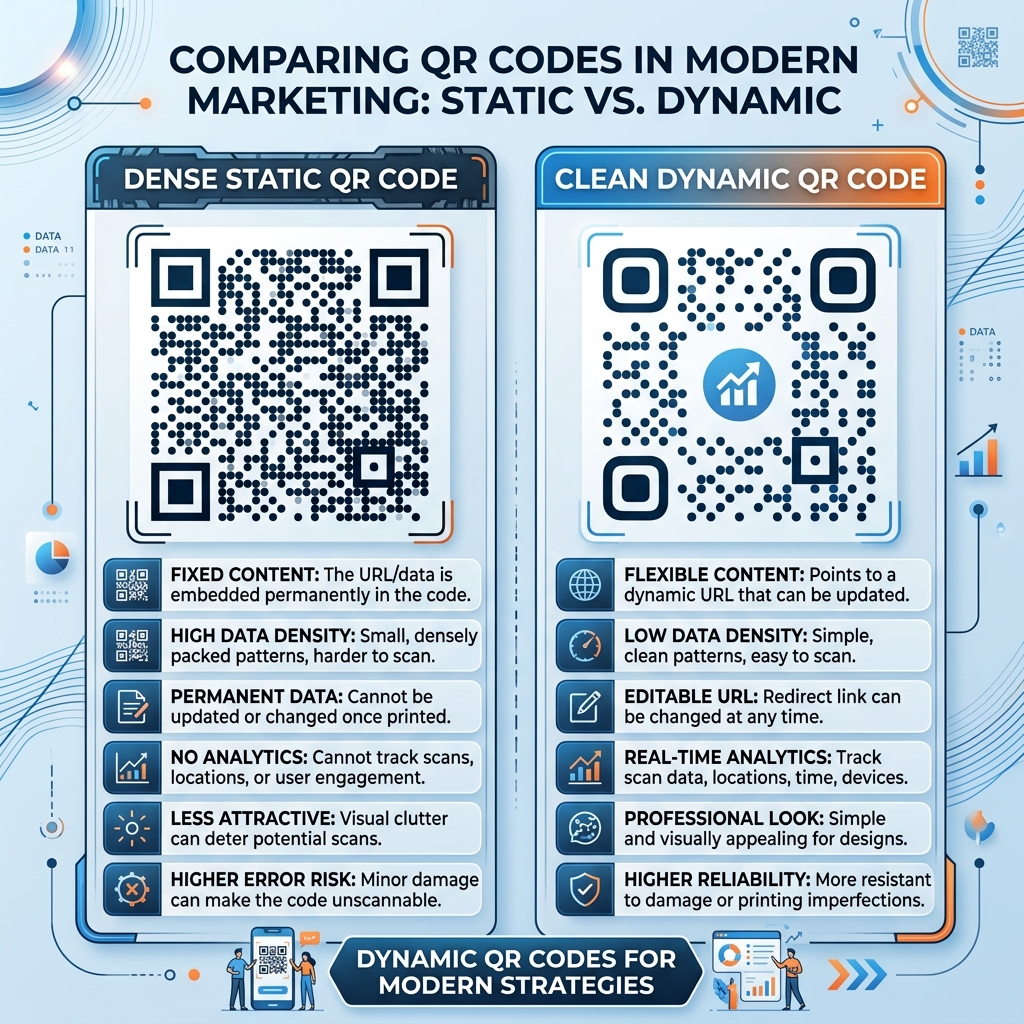
A static QR code stores the destination information directly within the code's pixel pattern. For example, if you generate a static QR code pointing to https://mywebsite.com/promotion, that exact text string is encoded into the black-and-white grid.
Pros of Static QR Codes
- Permanence: They never expire. As long as the destination URL remains active, the QR code will work forever.
- No Hosting Required: Since the data is stored directly in the code, they do not require database lookups or subscription renewals to function.
Cons of Static QR Codes
- Not Editable: Once printed, you cannot change the destination URL. If your website changes or contains a typo, the printed QR code becomes completely useless.
- No Tracking: You cannot track how many times the QR code was scanned, what devices were used, or where the scans occurred.
- Density Issues: The longer the URL or text you encode, the denser and more complex the QR grid becomes. Highly dense grids are very difficult for older cameras to scan.
What is a Dynamic QR Code?
A dynamic QR code does not store your final destination URL directly. Instead, it encodes a short, intermediate redirection URL (e.g., jkz.gr/qr123). When a user scans the code, their phone loads this short URL, and the redirection server instantly routes them to the actual destination URL.
Pros of Dynamic QR Codes
- Fully Editable: You can change the destination URL at any time in your dashboard, even after the QR code has been printed on billboards, flyers, or packaging.
- Comprehensive Tracking: Since traffic routes through a redirection server, you can track scan counts, date and times, scanner locations, and device types.
- Simplified Grid: Because the encoded short URL is very brief, the QR grid remains simple and clean. This ensures fast, reliable scanning, even when printed at small sizes.
Cons of Dynamic QR Codes
- Service Dependency: Dynamic QR codes depend on the redirection service (like JKZ Network) to remain active. If the service hosting the redirect ceases to function, the code will break.
Comparison: Static vs. Dynamic QR Codes
| Feature | Static QR Codes | Dynamic QR Codes |
|---|---|---|
| Edit Destination URL | No | Yes (Anytime) |
| Scan Tracking | No | Yes (Real-time analytics) |
| Grid Density | Increases with data length (Harder to scan) | Always minimal and clean (Easy to scan) |
| Best Use Case | One-time sharing, WiFi access, plain text | Marketing campaigns, product packaging, menus |
When to Use Static QR Codes
Static QR codes are perfect for scenarios where the information will never change and tracking is not required. Examples include:
- WiFi Access: Sharing your home or office WiFi login details with guests.
- Contact Cards (vCard): Sharing your phone number, email, and address on a business card.
- Personal Use: Sharing a simple text message or coordinate location.
When to Use Dynamic QR Codes
Dynamic QR codes are the industry standard for all business, commercial, and marketing applications. Use them for:
- Restaurant Menus: Update your menu items or prices without having to reprint table tents.
- Marketing Materials: Change the promotion page link from "Summer Sale" to "Autumn Launch" on the same printed brochure.
- Product Packaging: Link to assembly videos, user guides, or social media pages, keeping the destination content up-to-date.
- Trackable Events: Measure which advertising locations (e.g., store front vs. magazine ad) generate the most scans.
Conclusion and Next Steps
For businesses and marketers, dynamic QR codes are the clear winner. They offer the flexibility, reliability, and analytics needed to run professional, measurable offline-to-online campaigns without the risk of printing broken links.
Ready to build your first dynamic campaign? Create a free account on JKZ Network today to generate trackable QR codes. Check out our guide on How to Use QR Codes for Marketing Campaigns to maximize your scan rates.